

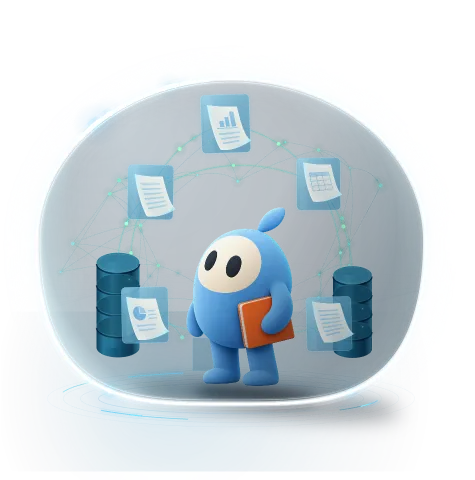
Per-customer isolation
No large database shared between companies. Each instance stays within its own boundaries and can use serverless inference or dedicated GPUs, depending on requirements.
Spine · sovereign AI for business
An AI assistant for each person, a shared memory for everyone. It manages your work, writes up your ideas, and connects them. What it learns benefits every employee, within each person's permissions.
The assistant
Spine isn't a general-purpose chatbot: it's the business assistant dedicated to your company. Fully immersed in your document ecosystem, it analyzes, organizes, and connects your data for your employees.
It reads and writes based solely on your company's documents (files, notes, projects). No web search: Spine works only from your internal data to update and enrich your documents.
No more duplicates or scattered files. Everything arrives already filed, with an assigned place, a date, and a full version history.
Human or AI: the author of every action is identified. Every task Spine performs is tracked along with its cost, for a smooth, instant review.
Custom document types. Start with the 15 built-in types and build the ones that save your teams time (site reports, meeting minutes, approval files). Every document follows your rules, your own business fields, and your permissions.
Automated know-how. Describe your way of working just once. The assistant takes it in and carries it out faithfully every time it steps in.
Memory
Memory that builds up. An improvement made on Tuesday becomes the standard for the whole team by Wednesday.
Know-how, written down. Quotes, follow-ups, meeting minutes: your methods are defined once and applied by everyone.
Knowledge that stays. When an employee leaves, the memory remains. No data loss, no complicated handover to plan for.
When an employee leaves the organization, what they've built up stays: nothing gets lost, nothing has to be rebuilt.
And the tools you already use? Project management, CRM, accounting, documents: Spine connects to your everyday work.
Explore integrations
The security bubble
Your Spine is an isolated environment dedicated to your company, hosted in Europe. Your data is never shared, whether with another customer or to train third-party models.


Environmental footprint
Designed to use the smallest model that does the job: your assistants make the best use of their resources, so nothing goes to waste.
See our approach
The app
Full mobility. Web, iOS, and Android apps. Access your work, projects, and notifications in real time, whether you're at the office or in the field.
An identity of its own. Customize your assistant's name and avatar. By giving it a specific mission and a manager, you make it an identifiable, reliable member of the team.
Spine frees your employees from repetitive tasks without ever taking their place. It doesn't replace anyone: it assists each person so they can focus on what matters.
Versus ChatGPT and Claude
Spine runs on the same AI models as the big chatbots. The difference is that you choose which ones, and that choice applies to the whole company. The intelligence is the same; the environment, and who it works for, aren't.
| Criterion | Spine | General-purpose chatbot |
|---|---|---|
| The AI model | Chosen by the company, the same for everyone, based on a trade-off between quality, cost, and sovereignty. Can be changed without rewriting anything. | The vendor's. It changes when the vendor decides, and differs from one employee to the next depending on their subscription. |
| Your data | It stays with you, in your bubble hosted in Europe. Nothing is copied out of the database. | Copied to the vendor's servers, in the United States by default. |
| Memory | A company memory: organized, time-stamped, versioned, shared according to permissions. | One memory per account, opaque, that leaves when the person does. |
| Your software | We connect your tools and choose exactly what's exposed, and to whom. | Standard connectors, often all or nothing. Anything custom is a separate project. |
| Cost | Based on actual usage, tracked action by action, with caps and alerts. | A fixed per-seat license, whether the person uses it or not. |
| Audit trail | Every document attributed, every version kept, every AI action visible with its cost. | A conversation history. Admin logs are reserved for enterprise plans. |

The power of a leading AI. The security of your company.
Spine integrates cutting-edge technology from OpenAI, Anthropic, and the best open-weight models, with the freedom to switch at any time. The difference? Instead of searching the entire internet, this intelligence focuses exclusively on your work and your processes, in the service of your teams.
Get started
On the technical side: your Spine bubble is set up and ready to use in 5 minutes.
On the human side: our implementation partners help your employees adopt these new ways of working and turn this assistant into a real performance driver.
An analysis of your data, your tools, and how you work. We precisely define the assistant's scope: what it needs to master from day one, and which confidential access must be protected.
Instant setup of your secure bubble, hosted by Scaleway. Your accounts, permissions, and connectors are up and running before your very first interaction.
Onboarding for the first teams, defining your business skills, and ongoing monitoring of usage, costs, and performance. Long-term oversight to ensure adoption and the project's success.
A free 30-minute intro call with the Spine team.
Spine · technical side
A dedicated instance, permissions enforced directly by PostgreSQL, connectors that run under the right identity, and your choice of AI models. Spine is designed to fit into your architecture without making you dependent on it.
Dedicated architecture
Each customer has its own application instance, database, authentication, and extensions. Data and processing stay inside a clearly identified bubble that can be operated and backed up as a self-contained unit.
No large database shared between companies. Each instance stays within its own boundaries and can use serverless inference or dedicated GPUs, depending on requirements.
PostgreSQL, REST API, OAuth, OIDC, MCP, OpenTelemetry, and Markdown: the key interfaces are well known, documentable, and replaceable.
Tool calls, models, usage, errors, and changes made by the AI all leave a usable trail.
Security and confidentiality
Confidentiality is enforced directly at the database level with Row-Level Security. The browser, the assistant, automations, and machine-to-machine access are all subject to the same security rule.
workspace IN my_workspaces()
What the user can't see never enters the model's context.
Memory and RAG
Spine structures company knowledge as typed, linked documents: a decision belongs to a project, concerns a client, comes from a meeting, and produces tasks. Semantic search builds on this structure instead of erasing it.
Hybrid search
Connectors
Spine distinguishes the capability the organization shares from the access an employee grants individually. The agent receives only the modules and permissions available to the person talking to it.
Shared scope
An administrator sets up a service for the company workspace or for a team. Authorized members then all get the same capability.
Individual scope
Each employee connects the services they choose from those the company allows. Their access, their permissions, and the data these unlock are never shared with any other user.
Configurable inference
The model is chosen at the instance level, not per employee: the whole company works on the same basis, with the same level of confidentiality and the same bill. This setting is a trade-off between quality, latency, cost, and sovereignty, and it can be changed without touching anything else.
Open-weight models served in Europe (Qwen, GLM, DeepSeek), OpenAI, Anthropic, or any other compatible infrastructure can provide the intelligence. Spine keeps its architecture, memory, permissions, and connectors; the provider determines the processing scope, not the product's capabilities.
By default, every message goes to the “Everyday” level, the fastest and least expensive in the line-up, and the footprint of each call is estimated: see our footprint.
Identity
Spine offers its own authentication and can join the company's existing directory: Microsoft Entra ID / Active Directory, Google Workspace, or any OIDC provider. Legacy SAML or LDAP environments can get a custom adapter.
Extensibility
Add a specific connector, a tool, a skill, an automation, or a document type unique to your organization. Customer extensions stay separate from the product core.
MCP access
Its MCP server exposes Spine's memory and capabilities to ChatGPT, Claude, and other compatible clients. Frontier models can then work with the company's context, without duplicating knowledge or bypassing access permissions.
This gateway allows a gradual transition from existing ChatGPT or Claude accounts: employees first keep their environment and habits, while accessing the same Spine core.
Portability
At any time, the company can export its entire memory in Markdown: content, properties, relationships, workspaces, and history, along with the original attachments.
An open format, readable without Spine and usable by your teams and your future tools alike.
projects/atlas.md
companies/asteria.md
meetings/committee-2026-09-12.md
attachments/quote-v4.pdf
relations.json
history/
manifest.jsonLet's talk about your situation